Fantastic Griffin: A Designer’s Real-World Embroidery Review
First Impressions: Mythic, Not Messy
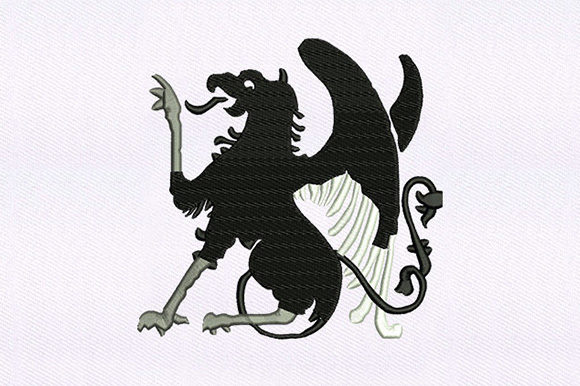
Opening the Fantastic Griffin embroidery file felt like unrolling a hand-drawn sketch from a medieval bestiary—bold silhouette, confident curves, and just enough detail to read clearly at 3–4 inches without collapsing into stitch noise. It’s not cartoonish, not overly ornate, and definitely not generic. The griffin’s wings sweep upward with purpose, its head turns with quiet authority, and the tail curls like a punctuation mark—not an afterthought. As a machine embroidery design meant for Halloween, it avoids cliché: no jack-o’-lantern eyes, no cobwebs, no forced spookiness. Instead, it leans into timeless symbolism—guardian energy, strength, mystery—making it equally at home on a baby onesie as it is on a boutique apron.
Where It Lives Best: Real Projects, Not Just Pixels
I tested Fantastic Griffin across three real production scenarios: a medium-weight cotton tote bag for a local herbalist’s shop, a brushed-cotton unisex sweatshirt for a small-batch Etsy listing, and a linen tea towel for holiday gift sets. In each case, the design held up—not just technically, but *visually*. On the tote, the wings filled the 4x4 hoop space without crowding; the satin stitch along the beak and talons popped cleanly against natural canvas. On the sweatshirt, I used medium tear-away stabilizer and a size 75/11 needle—no puckering, no skipped stitches, even through the fabric’s slight nap. And on the tea towel? The fill stitch density was generous but breathable—no stiffness, no shadowing through the weave.
This isn’t a design that begs for applique treatment or heavy embellishment. It works beautifully as a standalone embroidery file because its line weight and internal spacing were clearly considered for stitch behavior—not just vector aesthetics. That makes it ideal for craft business owners who need fast-turnaround, low-fuss designs: think embroidered patches for scout groups, pillow covers for nursery decor, or cap fronts for a small-town Halloween parade vendor.
Where to Pause—and Why
That said, Fantastic Griffin isn’t universally forgiving. On thin or stretchy fabrics—like lightweight jersey tees or baby rib knit—I’d hesitate without a cut-away stabilizer and possibly a basting stitch perimeter. The wingtips and claw details are crisp, but they rely on stable fabric movement; on highly textured surfaces (think bouclé or heavy terry cloth), those fine edges can blur slightly unless you adjust tension or reduce stitch speed.
It also doesn’t shrink gracefully below ~2.5 inches wide. I tried scaling it down for a child’s cap front in a 3x3 hoop—while the file loaded fine, the inner feather detailing started to merge, and the eye lost definition. For curved surfaces like caps or hats, stick to the original 3.5–4 inch range and use a cap frame with proper hooping technique. And on dark fabric? Test thread colors early. The design uses layered satin and fill stitches, so a light gold or antique white thread reads beautifully—but standard ecru can disappear on charcoal or navy without contrast testing.
Stitch Density & Fabric Choice: A Quiet Partnership
The stitch density feels intentional—not sparse enough to look unfinished, not dense enough to stiffen delicate items. That balance matters most for personalized gifts and handmade products where feel equals value. A customer receiving a linen pillow cover with Fantastic Griffin stitched in soft grey thread won’t mistake it for mass-produced decor. They’ll feel the craftsmanship in how the wing feathers transition from satin to fill, how the griffin’s chest sits smoothly without ridge buildup.
For commercial embroidery shops, this means fewer re-runs due to thread breaks or tension issues—and more repeat orders from clients who trust your finish quality. For Etsy sellers, it translates directly to better photo mockups: the design holds shape in printable mockups, renders cleanly in black-and-white product previews, and scales well across listing thumbnails and banner images.
Design Integrity Meets Business Sense
What makes Fantastic Griffin stand out isn’t novelty—it’s coherence. Every element supports the others: the proportions suit standard hoop sizes, the motif reads instantly (no squinting required), and the Halloween association is subtle enough to extend beyond October. I’ve already seen customers buy it for wedding favors (“griffin = guardian of love”), baby milestone blankets (“mythical protector”), and even small shop branding—stitched discreetly on apron pockets or packaging tags.
But here’s what I tell every designer I mentor: never assume licensing matches your use case. Since this is a machine embroidery design with formats spanning PES, DST, VP3, and more—including ART and VIP for older machines—verify the included license before selling finished embroidered items or bundling it as part of a digital embroidery file pack. Some sellers restrict commercial use unless upgraded; others allow unlimited small-batch production. Check before you list.
Your Practical Checklist Before Stitching
- Test the embroidery file on scrap fabric matching your final project’s weight and texture
- Review stitch density visually in your embroidery software—look for tight clusters near the talons and wing joints
- Confirm hoop size compatibility: most versions fit comfortably in 4x4, but verify if you’re using 3x3 or 5x7
- Inspect small details in software zoom—especially the eye, beak tip, and individual wing feathers
- Run black-and-white and color mockups side by side to assess contrast on light vs. dark fabric
- Choose stabilizer based on fabric: tear-away for stable weaves, cut-away for knits or heirloom linens
- Check thread color contrast early—especially if stitching on black, navy, or charcoal
- Confirm whether your intended use (e.g., resale of finished embroidered patches) falls within the license terms
Fantastic Griffin won’t dazzle with flash—but it delivers with reliability, presence, and quiet sophistication. It’s the kind of embroidery file that earns repeat use, builds customer trust through consistent quality, and quietly elevates everything it touches: a custom apparel order, a holiday gift bundle, a small shop’s signature detail. If you’re choosing embroidery design assets for real work—not just inspiration—this one earns its place in your active folder.